
America's 100 Greatest Public Courses
Our ranking of America’s 100 Greatest Public Courses provides a biennial snapshot into the state of affairs of public and resort golf course architecture. It also, increasingly, offers a peek into the wider world of golf development. High-end golf course construction—new courses and major remodels of existing clubs—has exploded the last six years in both quantity and quality. The top private clubs have resources not fathomable in the pre-covid era to spend on often elaborate renovations of their courses, and developers keep pushing the limits of where and how exotic they can construct new members-only outposts.
The rampant—and rapid—luxuriation of golf has migrated to public and resort golf. Green fees at many of the most highly ranked courses in our America's 100 Greatest Public now charge green fees between $500 and $1,000, and it can be a challenge to find options with rates less than $200. The downside of golf’s surging demand is this market’s reaction.
The ranking, however, based on tens of thousands of evaluations submitted by our traveling course-ranking panelists, is a reflection of the architectural merits of each course, not their affordability. And by that measure the level of excellence continues to be impressive: 33 of the courses ranked here also appear on America’s 100 and Second 100 Greatest Courses.
Would we like to see more affordable courses in ranking? Of course. But the other upside is that public options continue to grow, especially at resorts. Nine new courses debut on our list, highlighted by The Lido at Sand Valley rocketing in at No. 12 (The Lido has a private membership but offers select tee times to resort guests), Landmand, a standalone course in Nebraska from Rob Collins and Tad King ranked No. 24, and the new Pinehurst #10 design from Tom Doak (ranked 30th).
More from Golf Digest

New courses are on the way at other America’s 100 Greatest Public Courses standouts like Streamsong in Florida, Forest Dunes in Michigan and Gamble Sands in Washington State. We’ll see how they fare in 2027—and what they cost—but for those who want to indulge in spectacular golf that anyone can play (some would fairly say splurge), times have never been better.
Below you'll find our latest ranking of America's 100 Greatest Public courses in descending order:
We urge you to click through to each individual course page for bonus photography, drone footage and reviews from our course panelists. Plus, you can now leave your own ratings on the courses you’ve played … to make your case why your favorite should be ranked higher.

Evan Schiller

Evan Schiller

Evan Schiller

Evan Schiller

Evan Schiller

Brian Walters Photography


Evan Schiller Photography

Evan Schiller


.jpg.rend.hgtvcom.1850.1388.suffix/1644376859342.jpeg)
Evan Schiller
.jpg.rend.hgtvcom.1850.1388.suffix/1644376863336.jpeg)
Evan Schiller

Evan Schiller
.jpg.rend.hgtvcom.1850.1233.suffix/1644376867622.jpeg)
Russell Kirk

Russell Kirk


Visit Bloomington

Visit Bloomington

Visit Bloomington

Visit Bloomington

Visit Bloomington

Visit Bloomington

Visit Bloomington

Courtesy of the club

Dave Sansom


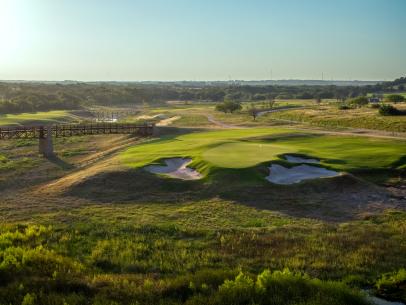
TPC San Antonio’s Oaks course has hosted the Valero Texas Open since 2010. Playing through the dry outlands north of the city, the Greg Norman design is one of the most strategically compelling courses on tour with aggressive bunkering, some wonderful short par 4s and several uniquely demanding par 5s, including the 18th, one of the most underrated and frustrating closing holes the professionals play.

NO. 92 Off-season rates of just over $100 make Tom Fazio’s Buffalo Ridge a compelling option. Photograph courtesy of Buffalo Ridge
Courtesy of the club

Derek Duncan

LC Lambrecht

LC Lambrecht

LC Lambrecht


Courtesy of Quintero

Courtesy of Quintero

Courtesy of Quintero

Kohler, WI

Destination Kohler

Destination Kohler

Destination Kohler

More From Golf Digest


Stephen Szurlej

The Redan par-3 seventh.
Trey Wren

Trey Wren

The par-3 17th.
Derek Duncan

The bare, crowned green at the par-4 13th.
In the current age of new elite private clubs and faraway destination resorts, the opening of a public municipal-affiliated golf course in an urban area is major news—especially when Tiger Woods shows up for the grand opening, like he did in March 2023.
The Park is the latest in a growing trend of public/private partnerships that have fueled the redevelopment of numerous municipal courses around the country. The new course is set on the site of the former Dick Wilson-designed West Palm Beach Golf Course, one of the first notable designs of the post-World War II years when it opened in 1947 and long considered among the top municipal courses in the country.
That course closed in 2018 due to deteriorating playability and diminished interest and sat fallow for several years. Several plans for different uses of the land were proposed before a group of local citizens, led in part by Seth Waugh, CEO of the PGA of America, raised $56 million in individual donations to re-imagine the property as a community gathering space with amenities that include, in addition to golf, youth activities and educational programs, shopping and dining. Woods was one of the donors. (Note: the PGA of America is not connected to the project.)
The fundraisers and City of West Palm Beach hired Hanse and Wagner to create a new 18-hole course on the property’s existing site, located just off I-95 less than two miles south of the Palm Beach International Airport. Also included in the redevelopment is a state-of-the-art practice facility, a lighted nine-hole short course and a two-acre children’s-only golf zone.
Hanse and Wagner retained nothing of the Wilson course and originally envisioned using its deep, sandy terrain to craft holes that would look and play like the Sand Belt courses of Melbourne, Australia. In routing the course, however, they removed pockets of trees, palmetto and other vegetation—crucial ingredients of Sand Belt courses—that would have enhanced that effect.
“One of the cool things Tiger said when he was here, and he’s been by a few times, was this is a ‘one-ball course’—you’re not going to lose a ball out here,” Hanse says.
Read Derek Duncan's full piece here.

Courtesy of Mid-Pines GC/kevinmurraygolfphotography.com

Brendan Caffrey

Brendan Caffrey

Stephen Szurlej

Courtesy of the club

NO. 95 Escapist golf doesn’t have to cost a lot: Fees at Black Mesa in New Mexico are frequently less than $80. Photograph by Patrick Koeing
Patrick Koenig

Brian Oar

From Golf Digest Architecture Editor emeritus Ron Whitten:
Dan Proctor and Dave Axland have been quasi-legends in the business of golf course construction for over 30 years now, individually and collectively. They've worked on many of Coore & Crenshaw’s prominent designs, including Sand Hills (Nebraska's premier layout, in the center of the state's vast sand hills) and Cabot Cliffs (Canada's premier layout these days). They even rated cameo appearances in Geoff Shackleford’s 1998 novel, The Good Doctor Returns. And they were also a talented course design team in their spare time, routing and building quality low-budget courses in the Coore & Crenshaw style.
Their most prominent collaboration is Wild Horse in central Nebraska, a public “little brother” to Sand Hills, in slightly softer but still authentic sand hills, closer to civilization. Like at Sand Hills, Wild Horse is lay-of-the-land architecture routed without benefit of topographic maps, with natural-looking bunkers, native grass roughs and pitch-and-run shots galore. Total earth moved: 5,000 cubic yards. Total construction costs: a little less than $1 million.
In my opinion, it's the best low-cost golf course in the nation. I admit I'm showing provincialism here. I was born and raised in Nebraska, and I'm partial to her natural treasures, of which Wild Horse is certainly one. There are many other fine public courses in the Midwest that are even less expensive to play than this one, but none, I will argue, will give you quite as genuine a prairie links experience as Wild Horse.
Explore our complete review here—including bonus photography and ratings from our expert panelists.

Brian Walker


From Golf Digest Architecture Editor emeritus Ron Whitten:
Back in mid-1980s, George Bryan, who ran Bryan Foods, now part of Sara Lee Corp., created Old Waverly Golf Club in tiny West Point, Miss., a Bob Cupp/Jerry Pate design and former U.S. Women’s Open host that to me is a bit underrated.
In the early 2000s, Bryan bought an old dairy farm (Knob Hill Dairy) across the highway and hired Gil Hanse to give him an Old School public golf course. George named it Mossy Oak, after a West Point company of the same name that supplies outdoor camouflage gear. (The company has a 10-percent interest in the course.) He was going to call it Howlin' Wolf after a legendary blues singer born in West Point, but his heirs wanted too much money.
Hanse got the job before he was awarded the Rio Olympics design in 2012, and it was the first project he tackled after completing his work in Brazil. The site footprint is smaller than Old Waverly across the road, but except for some cottages along No. 10, there's no residential on Mossy Oak, so the course feels more expansive.
Explore our complete review here—including bonus photography and ratings from our expert panelists.

Evan Schiller

Evan Schiller

Evan Schiller

Evan Schiller

Evan Schiller

Evan Schiller

Matt Suess/Courtesy of Big Cedar Lodge
From architecture editor Derek Duncan:
It was a long time coming. That’s not a reference to the three-and-a-half-years of construction and grow-in for Payne’s Valley, the newest resort course at Big Cedar Lodge near Branson, Mo. Rather, it had been 14 years since public golfers began waiting to play a course designed by Tiger Woods.
Woods founded his design company, TGR Design, in 2006. But because of his schedule, the desire to be selective of the few projects he signs onto and a devastating financial crisis, only two TGR courses were been completed—the El Cardonal course at Diamante Cabo San Lucas in Mexico, and Bluejack National, a private course in Texas. Payne’s Valley, which opened in 2020, presents to the largest audience to date the architectural principles he most values.
“My goal when starting TGR Design was to create courses that are fun and playable for golfers of all abilities,” Woods told Golf Digest. “This was particularly important at Payne’s Valley, my first public golf course.”
RELATED: Tiger Woods has been passionate about course design for longer than you might think
Woods has always been at his best on the biggest stages, and Payne’s Valley, named for the late Payne Stewart, who grew up in nearby Springfield, is unquestionably big.
Explore our complete review here—including bonus photography and ratings from our expert panelists.


More from Golf Digest


Courtesy of the club

Courtesy of the club


Evan Schiller


Courtesy of the club

Courtesy of the club

Courtesy of the club

Courtesy of the club


Courtesy of the club/Bill Hornstein

Courtesy of the club


_Credit%20Dave%20Burk.jpg.rend.hgtvcom.1850.1233.suffix/1668111742331.jpeg)
Dave Burk
_Credit%20Could%20Be%20the%20Day.jpg.rend.hgtvcom.1850.1041.suffix/1668111737565.jpeg)
Dave Burk

Alex S. MacLean
_Credit%20Dave%20Burk.jpg.rend.hgtvcom.1850.1233.suffix/1668111739972.jpeg)
Dave Burk
_Credit%20Dave%20Burk.jpg.rend.hgtvcom.1850.1233.suffix/1668111741220.jpeg)
Dave Burk


L.C. Lambrecht

Courtesy of Rees Jones
_Credit%20Could%20be%20the%20Day.jpg.rend.hgtvcom.1850.1233.suffix/1668111738571.jpeg)
Dave Burk

Courtesy of the club

Courtesy of the club

Allen Kennedy

Brendan Caffrey
.jpg.rend.hgtvcom.1850.1233.suffix/1651089189379.jpeg)
Courtesy of the club


More from Golf Digest

Evan Schiller

Evan Schiller

Evan Schiller

Evan Schiller

Evan Schiller

Evan Schiller

Evan Schiller

Evan Schiller

Evan Schiller

Evan Schiller

Evan Schiller

Evan Schiller

Evan Schiller

Evan Schiller

Evan Schiller

Evan Schiller

Brian Oar

Brian Oar

Barbara Kraft

Courtesy of the club

Kohler, WI

Destination Kohler


Destination Kohler

Courtesy of the club

Courtesy of the club


Evan Schiller

Evan Schiller

Evan Schiller

Evan Schiller

Evan Schiller

Evan Schiller

Evan Schiller

Evan Schiller

Evan Schiller

JFHenebry/Courtesy of the club

JFHenebry/Courtesy of the club

JPHenebry

JFHenebry/Courtesy of the club


Courtesy of the club


Dom Furore

Chris Keane

Stephen Szurlej

John and Jeannine Henebry


Evan Schiller/Courtesy of Giants Ridge

Evan Schiller/Courtesy of Giants Ridge

Evan Schiller/Courtesy of Giants Ridge

Evan Schiller/Courtesy of Giants Ridge

Evan Schiller/Courtesy of Giants Ridge


NO. 44 Wilderness Club in northern Montana is the most remote course on our ranking. Photograph by Patrick Koeing
Patrick Koenig


Evan Schiller

Evan Schiller

Evan Schiller

Evan Schiller

Evan Schiller

Evan Schiller

Patrick Koenig

Patrick Koenig

Jeff Marsh

.jpg.rend.hgtvcom.1850.1233.suffix/1651613132812.jpeg)
Courtesy of the club


Courtesy of the club

Courtesy of the club
%20-%20GW%20Hole%207.jpg.rend.hgtvcom.1850.1233.suffix/1651613155364.jpeg)
Lukas Michel
%20GW%20-%20Hole%2015.jpg.rend.hgtvcom.1850.1233.suffix/1651613171028.jpeg)
Lukas Michel

Courtesy of the club

Courtesy of the club

Courtesy of the club

Courtesy of the club

Courtesy of the club

Courtesy of the club

Paul Hundley/Courtesy of the club

Courtesy of the club

Chris Black

Chris Black

Chris Black

Chris Black

Courtesy of the club


Sherman Chu

Jeff Marsh

Channing Benjamin

Courtesy of the resort


Joey Terrill

Courtesy of Rosewood Cordevalle
More from Golf Digest

Brandon Carter

Brandon Carter

Brandon Carter

Brandon Carter

Brandon Carter
More From 100 Greatest Public

Jeff Marsh
Matt Majka/Courtesy of Cabot Citrus Farms

Matt Majka

Jeff Marsh


Matt Majka

Jeff Marsh


Jeff Marsh

Jeff Marsh
From managing editor Stephen Hennessey:
When arriving at Cabot Citrus Farms you’ll understand why Ben Cowan-Dewar sought this property for decades. A prehistoric ridge in Brookville, Fla., created rolling topography on sandy soil—a golf developer’s dream.
In the early 1990s, World Woods opened with two acclaimed public courses and what was once the world’s largest driving range that hosted Tiger Woods commercial shoots. But playing conditions had deteriorated at World Woods. Its Pine Barrens course, once the 75th-best course in Golf Digest's ranking of America’s 100 Greatest Courses, quickly fell off that list in 2013.
Cowan-Dewar inquired about the property with the previous owner, Japanese businessman Yukihisa Inoue, in 2014 and 2016, to no avail. Others also tried to buy it. Finally, as COVID-19 restricted travel, Cowan-Dewar chatted with Inoue through translators over Zoom and negotiated to purchase the property in 2021—giving his burgeoning Cabot resort and real estate empire its first U.S. offering.
That decades-long courtship has now paid off with Cabot Citrus Farms’ Karoo course, which opened this winter. Kyle Franz—known for his meticulous remodeling of North Carolina sandhills courses such as Mid Pines, Pine Needles and Southern Pines—transformed the existing Pine Barrens course with Karoo, the first course to open. He reversed playing corridors in some cases, completely changing what was in the ground in many cases. You see that immediately on the first hole—a massive double green for the first and sixth holes.
For a complete review of the newly opened Karoo course, click here.

Fred Vuich

Andy Anderson


Andy Anderson (208.587.3161)


Dick Durrance II

Dick Durrance

Dick Durrance

Dick Durrance II

Dick Durrance

Dick Durrance II


Dick Durrance

Dick Durrance II


Evan Schiller

Evan Schiller

Evan Schiller

Evan Schiller


Evan Schiller

Evan Schiller

Evan Schiller
Evan Schiller

Stephen Szurlej

Photo by Stephen Szurlej

Courtesy of the club

Courtesy of the club

Courtesy of the club

courtesy of Sea Island

courtesy of Sea Island

courtesy of Sea Island

courtesy of Sea Island

courtesy of Sea Island

courtesy of Sea Island

courtesy of Sea Island
courtesy of Sea Island

Brian Oar

Brian Oar


Billy Richards

Billy Richards

Kevin Patrick Murray

Brian Oar

Brian Oar

Mauna Kea Resort

Courtesy of the club

Courtesy of the club

Courtesy of Mauna Kea Beach Hotel

Courtesy of Omni Hotels & Resorts

Courtesy of Omni Hotels & Resorts

Courtesy of Omni Hotels & Resorts

Courtesy of Omni Hotels & Resorts

Courtesy of Omni Hotels & Resorts

Courtesy of Omni Hotels & Resorts

Courtesy of Evan Schiller

Courtesy of Evan Schiller

Courtesy of Evan Schiller

Courtesy of Evan Schiller

Courtesy of the club

Courtesy of Evan Schiller


 - 12th hole - courtesy of the club.jpg.rend.hgtvcom.406.203.suffix/1573162816013.jpeg)

%20-%20Jon%20Cavalier.jpeg.rend.hgtvcom.1850.1041.suffix/1573163040843.jpeg)
Jon Cavalier
%20aerial%20-%20Jon%20Cavalier.jpeg.rend.hgtvcom.1850.925.suffix/1573163020034.jpeg)
%20-%20Jon%20Cavalier.jpeg.rend.hgtvcom.1850.1041.suffix/1573163022347.jpeg)
%20-%20%20Jon%20Cavalier.jpeg.rend.hgtvcom.1850.1041.suffix/1573163039014.jpeg)
%20%20-%20Jon%20Cavalier.jpeg.rend.hgtvcom.1850.1041.suffix/1573163026346.jpeg)

Courtesy of The Greenbrier
%20-%20Dan%20Murphy%20_%20Stonehousegolf.com.jpg.rend.hgtvcom.1850.617.suffix/1573162869165.jpeg)
Courtesy of DANIEL JAMES MURPHY

Courtesy of DANIEL JAMES MURPHY
%20-%20Dan%20Murphy%20_%20Stonehousegolf.com.jpg.rend.hgtvcom.1850.617.suffix/1573162837554.jpeg)
Courtesy of DANIEL JAMES MURPHY

Courtesy of DANIEL JAMES MURPHY

Courtesy of DANIEL JAMES MURPHY

Courtesy of DANIEL JAMES MURPHY

LC Lambrecht


BEN WALTON

BEN WALTON

BEN WALTON

Evan Schiller

Dom Furore

Courtesy of Evan Schiller

Evan Schiller

Brian Walters Photography

Courtesy of Evan Schiller

Courtesy of Evan Schiller

Courtesy of Evan Schiller

Evan Schiller

Evan Schiller

Evan Schiller

Evan Schiller

Evan Schiller
From Golf Digest Architecture Editor emeritus Ron Whitten:
The Tom Weiskopf-designed Forest Dunes in Michigan is a terrific layout on a terrific piece of property, with sand dunes deposited by the nearby Au Sable River and covered with mature pines.
But it's not a unique piece of property. When I first played it, I was struck by how much Forest Dunes resembles a Texas course designed by Weiskopf's former partner, Jay Morrish. That course, Pine Dunes in Frankston, Texas, is built on much the same terrain, sand dunes covered in pines. Though they were working at the same time on their respective projects (Forest Dunes was completed in 2000 but didn't open until 2002; Pine Dunes opened in 2001), I don't think Weiskopf or Morrish had any idea that they were working on such similar courses, and I don't think they stole each other's ideas. But it's uncanny how they created kissing-cousin courses. Or maybe not. The two worked together for over a decade before splitting up in 1996, and they shared a common philosophy of course design.
Both courses have split personalities, with portions that look like Augusta National—lots of grass, trees, pine needles and gleaming white sand bunkers—and other portions that look like Pine Valley—rugged holes edged by roughs of brownish native sand and scruffy underbrush. Each have one long par 4 (the second at Forest Dunes, the fourth at Pine Dunes) that curves to the left through trees, has no fairway bunkers but has one big bunker at the left front of the green. Both have par-3 16th holes that play over wasteland to an angled green with bunkers right and left. Both courses have very similar drive-and-pitch par 4s.
Explore our complete review here—including bonus photography and ratings from our expert panelists.

Stephen Szurlej

Courtesy of Black Desert Resort


Courtesy of Black Desert Resort

Courtesy of Black Desert Resort

Courtesy of Black Desert Resort

Courtesy of Black Desert Resort

Courtesy of Black Desert Resort

Courtesy of Black Desert Resort

Courtesy of Black Desert Resort


Courtesy of Black Desert Resort

Hanse's 18th hole has a number of strategic elements to navigate.

A massive bunker complex at the 15th hole guards the green.

The East course's 13th hole looks like it always sat naturally within these live oaks and mesquite trees.

The greensite at the 10th hole is carved into the property's natural features.

The rugged eight green complex at the East.

.jpg.rend.hgtvcom.1850.1041.suffix/1644519945505.jpeg)
The punchbowl ninth green at Streamsong (Black).
LC Lambrecht

LC Lambrecht

LC Lambrecht

Courtesy of Laurence Lambrecht

LC Lambrecht

Courtesy of Laurence Lambrecht

LC Lambrecht

LC Lambrecht

Stephen Denton

Courtesy of Pinehurst Resort

Pinehurst Resort

.jpg.rend.hgtvcom.1850.1041.suffix/1588620726965.jpeg)


Brian Oar

Photo by Stephen Szurlej

Stephen Szurlej

Stephen Szurlej

Stephen Szurlej

Stephen Szurlej

Stephen Szurlej

Stephen Szurlej

Stephen Szurlej

Stephen Szurlej

Stephen Szurlej

Stephen Szurlej

Stephen Szurlej

Stephen Szurlej

Stephen Szurlej

Stephen Szurlej

Jeff Marsh

Matt Gibson/Pinehurst Resort

Jeff Marsh

Jeff Marsh

Jeff Marsh


Matt Gibson/Pinehurst Resort
More from Golf Digest

Courtesy of the club

Courtesy of Michael Clemmer

Courtesy of the course

Courtesy of the club

Courtesy of the course

Courtesy of the club

Courtesy of the club

Courtesy of the club

Courtesy of the club

Courtesy of the club

Courtesy of Michael Clemmer

Courtesy of the club

The Sea Pines Resort/Bill Hornstein

The Sea Pines Resort/Bill Hornstein

The Sea Pines Resort/Bill Hornstein

The Sea Pines Resort/Bill Hornstein

The Sea Pines Resort/Bill Hornstein

Dom Furore

Dom Furore

Dom Furore

Dom Furore

Dom Furore

Dom Furore

Dom Furore

Dom Furore

Dom Furore

Laurence Lambrecht

Courtesy of Laurence Lambrecht

Courtesy of Laurence Lambrecht

Courtesy of Laurence Lambrecht

Courtesy of Laurence Lambrecht

Courtesy of Laurence Lambrecht
More from Golf Digest


Jeffrey R. Bertch

.jpg.rend.hgtvcom.1850.1388.suffix/1573162768927.jpeg)
Courtesy of Jeffrey R. Bertch

Courtesy of Evan Schiller
.jpg.rend.hgtvcom.1850.1388.suffix/1573162769716.jpeg)
Courtesy of Jeffrey R. Bertch

Courtesy of Jeffrey R. Bertch

Bill Hornstein

From architecture editor Derek Duncan:
Actor Nicolas Cage once ate a live cockroach for a film he was shooting. Later, when asked why—he could have eaten a pretend insect—he responded, “Anything less wouldn’t be real.”
The conceit is that at times the only way to fulfill the potential of a given situation—a movie scene, a piece of art, a military offensive—is to push as far and aggressively as possible. This principle applies to Landmand, a new design in northeastern Nebraska about 10 miles from Sioux City, Iowa. The course sits on a vast, elevated section of loess formations with eroded furrows and valleys. It winds across the bluffs and between valleys, and from the tops of the ridges horizon views of 20 miles or more are possible, filling the landscape with a feeling of unlimited proportion. Given the setting, it’s impossible to discern the scale of the features in the near and middle distance, and the only way for architects Rob Collins and Tad King to make the golf look like it fit against the endless backdrops was to construct fairways 80 to 100 yards wide and greens that are, cumulatively and in some cases individually, the largest in the United States. Anything less wouldn’t be right.
Explore our complete review here—including bonus photography and ratings from our expert panelists.

Courtesy of Dave Sansom

Courtesy of Dave Sansom

Courtesy of Dave Sansom

Courtesy of Dave Sansom

Dave Sansom

From Golf Digest Architecture Editor emeritus Ron Whitten:
Most golf fans are familiar with Kapalua Golf Club’s Plantation Course, home of the PGA Tour's opening event each year. Located on the north shore of the Hawaiian island of Maui, the Plantation was built from open, windswept pineapple fields on the pronounced slope of a volcano and is irrigated by sprinklers pressured solely by gravity.
As the first design collaboration by Bill Coore and Ben Crenshaw, it unveiled their joint admiration for old-style courses. The blind drive on the fourth, the cut-the-corner drives on the fifth and sixth are all based on tee shots found at National Golf Links. So, too, are its punchbowl green and strings of diagonal bunkers.
It's also a massive course, built on a huge scale, Coore says, to accommodate the wind and the slope and the fact that it gets mostly resort play.
So it's a big course. But what sets it apart in my mind are the little things. When I played the course years ago with Coore, it took only one hole for me to appreciate one of its subtleties. We were on the tee of the par-3 second, an OK hole but nothing riveting, nothing like the canyon-carry par-3 eighth or the ocean-backdropped par-3 11th. The second sits on a rare flat portion of the property. The green sits at a diagonal, angling left to right, and there's a string of bunkers staggering up the right side of the green. The first bunker appears to be directly in front of the green but is actually 40 yards short of it. When pointed out to me, I called it Gingerbread. Bill disagreed.
Explore our complete review here—including bonus photography and ratings from our expert panelists.


Courtesy of Jeffrey R. Bertch


Courtesy of Jeffrey R. Bertch

Courtesy of Jeffrey R. Bertch

Courtesy of Jeffrey R. Bertch

.jpg.rend.hgtvcom.1850.1233.suffix/1573350177068.jpeg)

Matt Hahn

LC Lambrecht

LC Lambrecht

LC Lambrecht

LC Lambrecht

LC Lambrecht

LC Lambrecht

LC Lambrecht

LC Lambrecht



Courtesy of Jon Cavalier

Courtesy of Jon Cavalier

Courtesy of Jon Cavalier

Courtesy of Jon Cavalier

Courtesy of Jon Cavalier

Courtesy of the club

courtesy of French Lick Resort


Brian Walers Photography

Brian Walers Photography


Courtesy of Jon Cavalier

Kohler, WI

Destination Kohler

Destination Kohler

Courtesy of Kohler Co.

Photographed by Dom Furore at Arcadia Bluffs in Michigan.

Dom Furore

Nile Young Photography/Courtesy of Arcadia Bluffs GC

Nile Young Photography/Courtesy of Arcadia Bluffs GC

Photo courtesy of Arcadia Bluffs

Nile Young Photography/Courtesy of Arcadia Bluffs GC

Nile Young Photography/Courtesy of Arcadia Bluffs GC

Evan Schiller

Evan Schiller

Evan Schiller

Evan Schiller

Stephen Szurlej

Stephen Szurlej

Stephen Szurlej

Stephen Szurlej

Stephen Szurlej

Stephen Szurlej

Evan Schiller

Courtesy of Pebble Beach Company

Courtesy of Pebble Beach Company

Courtesy of Pebble Beach Company

Brandon Carter

Brandon Carter

Brandon Carter

Brandon Carter

Brandon Carter

Brandon Carter

Brandon Carter

Brandon Carter

Stephen Szurlej

Stephen Szurlej

Stephen Szurlej

Stephen Szurlej

Stephen Szurlej

Stephen Szurlej

Stephen Szurlej

Stephen Szurlej
More From Golf Digest

Paul Hundley

Dom Furore

Dom Furore


Dom Furore


Dom Furore

Dom Furore

Stephen Szurlej

Stephen Szurlej

Stephen Szurlej

Stephen Szurlej

Stephen Szurlej

Stephen Szurlej

Stephen Szurlej

Stephen Szurlej

Wood Sabold/Courtesy of Bandon Dunes Golf Resort

Dom Furore / Golf Digest

Dom Furore / Golf Digest


Courtesy of TPC Sawgrass

Courtesy of TPC Sawgrass

Courtesy of TPC Sawgrass


Dom Furore

The menacing surrounds at Bethpage Black's sixth green.
Dom Furore

Stephen Szurlej

The view behind the sixth green from 7 tee.
Stephen Szurlej

The ultra-difficult stretch of Bethpage Black's par-4 10th (right), requiring extreme precision off the tee, with the 11th hole—a Pine Valley-like par 4 that also requires a ball stay out of the extended bunker lobes.
Stephen Szurlej

The 517-yard, par-5 fourth hole is guarded by a classic cross bunker.
Stephen Szurlej

Stephen Szurlej

The par-4 12th's widened fairway gives golfers a bailout option.
Stephen Szurlej

Behind the 16th green.
Stephen Szurlej

Bethpage Black's home hole.
Photo by Stephen Szurlej

Stephen Szurlej


Dom Furore

Stephen Szurlej

Dom Furore

The 13th hole at Pinehurst No. 2.
Courtesy of the resort

Dom Furore

Dom Furore

Carlos Amoedo

Carlos Amoedo

Stephen Szurlej

Stephen Szurlej

Behind the third green at the Ocean Course.
Uzzell Lambert

Photo by Stephen Szurlej

Stephen Szurlej
More from Golf Digest



Carlos Amoedo

Stephen Szurlej

Carlos Amoedo

Stephen Szurlej

Stephen Szurlej

Stephen Szurlej

The Henebrys/Courtesy of Shadow Creek GC

Courtesy of Shadow Creek GC

The Henebrys/Courtesy of Shadow Creek GC


Stephen Szurlej

Stephen Szurlej

Stephen Szurlej

Stephen Szurlej

Stephen Szurlej

Stephen Szurlej

Stephen Szurlej

Stephen Szurlej

Stephen Szurlej
](http://golfdigest.sports.sndimg.com/content/dam/images/golfdigest/fullset/2015/07/21/55ad8e76add713143b42e65b_courses-2013-02-cosl19_pacific_dunes_618.jpg.rend.hgtvcom.1850.1321.suffix/1573448799923.jpeg)
Stephen Szurlej

Stephen Szurlej

Sherman Chu


Evan Schiller


Getty Images


Photo by Joann Dost

Keyur Khamar

Stephen Szurlej
More From Golf Digest

• • •
Explore Golf Digest's new Course Reviews section where you can submit a star rating and evaluation on all the courses you’ve played. We've collected tens of thousands of reviews from our course-ranking panelists to deliver a premium experience, which includes course rankings, experts' opinions, bonus course photography, videos and much more. Check it out here!